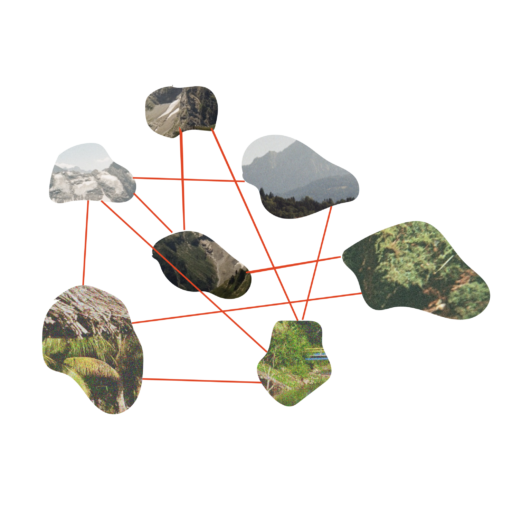
Regenerative design is a way of thinking about how we create in relationship with the living world around us. It asks how human systems and natural systems can support one another over time rather than exist in conflict. It is not only about the final object, building, or service. It is also about the relationships behind it. The flows of energy and materials. The people involved. The place it belongs to. The ecological systems it touches. Regenerative design is about participation. It asks how design can contribute to the health of a system instead of taking from it.
Rooted in place
One of the most important things about regenerative design is that it is never one size fits all. It changes from place to place because every landscape, community, and culture has its own conditions, histories, and needs.
What feels regenerative in one context may not make sense in another. That is why local knowledge matters so much. Listening matters. Observation matters. So does understanding the deeper character of a place before trying to intervene in it.
The Anthology of Regenerative Futures by Unearthodox describes regeneration as “a forest of perspectives rather than a single definition.” In other words, regeneration is not a fixed formula. It is something living, relational, and constantly unfolding.
Why it matters
We are living with the consequences of systems that were often designed for speed, growth, and extraction without much attention to long term health. You can feel that in the environment, but also in communities, economies, and everyday life.
That is part of why regenerative design is so important right now.
It offers another way forward. One that is more attentive. More connected. More responsible. It reminds us that design has never been neutral. The things we create shape behavior, shape values, and shape the world around us.
If design has helped build many of the systems we live inside, then it also has a role in helping rethink them.
The role of design
Design has the power to influence far more than aesthetics. It shapes how we move through spaces, how we use resources, how we relate to one another, and what kinds of futures become possible.
In a regenerative approach, the role of design is not to control everything. It is to understand relationships more deeply and respond with care. That might mean designing in a way that supports local ecosystems, strengthens community connection, works with regional materials, or creates systems that can adapt and evolve over time.
It also means learning from living systems. Not copying nature on the surface, but paying attention to how nature works. Cycles, interdependence, resilience, diversity, renewal. These are not just ecological ideas. They are design ideas too.
Regeneration and time
Regenerative design also asks us to question the way we relate to time.
So much of modern life treats time as something fixed and absolute. Something to measure, compress, and optimize. But one of the most compelling ideas in physics is that time is not fully separate from the system around it. In relativity, time is shaped by relationships. It depends on position, motion, and context. That feels meaningful here. Regeneration also depends on context. It asks us to stop assuming that every system should move at the same speed or follow the same timeline.
A forest, a coastline, a neighborhood, and a supply chain all change at different rates. Some systems can shift quickly. Others need decades. Regenerative design requires sensitivity to those different temporal scales. It asks us to look beyond immediate results and think about what a design makes possible over time. What it restores. What it strengthens. What it allows to emerge slowly.
In that sense, regenerative design is not only about creating better things. It is about learning how to work within deeper temporal realities. To design not just for the present moment, but for processes already in motion and futures still taking shape.
How to bring it into your own life
You do not have to be working on a large scale project to begin thinking in a regenerative way.
It can start very simply. Paying more attention to where things come from. Supporting local makers. Repairing instead of replacing. Being more aware of the systems behind everyday life. Asking questions. Who made this? What does it depend on? What does it give back?
It can also mean becoming more connected to a place. Learning the materials, histories, and ecologies around you. Slowing down enough to notice what already exists before deciding what needs to be added.
It also means thinking differently about time. Not just choosing what is easiest now, but asking what can last, adapt, and grow more meaningful over time. What can deepen through use, care, and continued relationships.
Regenerative thinking starts there. With questioning what we take for granted. With awareness. With relationships. With the understanding that our lives are part of larger living systems, not separate from them.
An ongoing practice
Regenerative design is still being defined, and that is part of its value. It leaves room for learning. For adaptation. For multiple voices and ways of knowing.
More than anything, it feels like an invitation. To design with more humility. To pay closer attention. To create in ways that support life, not just function. Not to arrive at one perfect definition, but to keep asking how design can help build healthier relationships between people, place, and the world that holds us.