Many communities and individuals are led to believe that meaningful change will arrive from somewhere else. Help will come from the government, an international organization, a wealthy investor, a new technology or a future generation. Opportunity is imagined as existing in the city, abroad or at some later point in time.
Kairos Futura describes this pattern as "the elsewhere delusion." This creates passivity by teaching people to wait for someone with more money, authority or expertise to solve local problems. It can also encourage people to leave rural communities because possibility appears to exist only elsewhere.
When residents leave, communities can lose skills, cultural memory, relationships and the younger people who might otherwise contribute to their future. Meanwhile, polluting industries and other unwanted activities may move to the outskirts of cities where land is less expensive, placing additional environmental pressure on surrounding rural communities.
The crisis of imagination
Kairos Futura also responds to a "crisis of imagination." Schools, institutions and social pressures often reward people for following predetermined paths rather than questioning, dreaming or experimenting. Creativity becomes treated as a luxury rather than as a basic capacity needed to respond to uncertainty.
When people are repeatedly shown futures designed elsewhere, they may lose the ability to imagine futures grounded in their own landscape, culture and experience. Without imagination, communities can describe what is wrong but struggle to envision what might replace it.
A way to address these issues
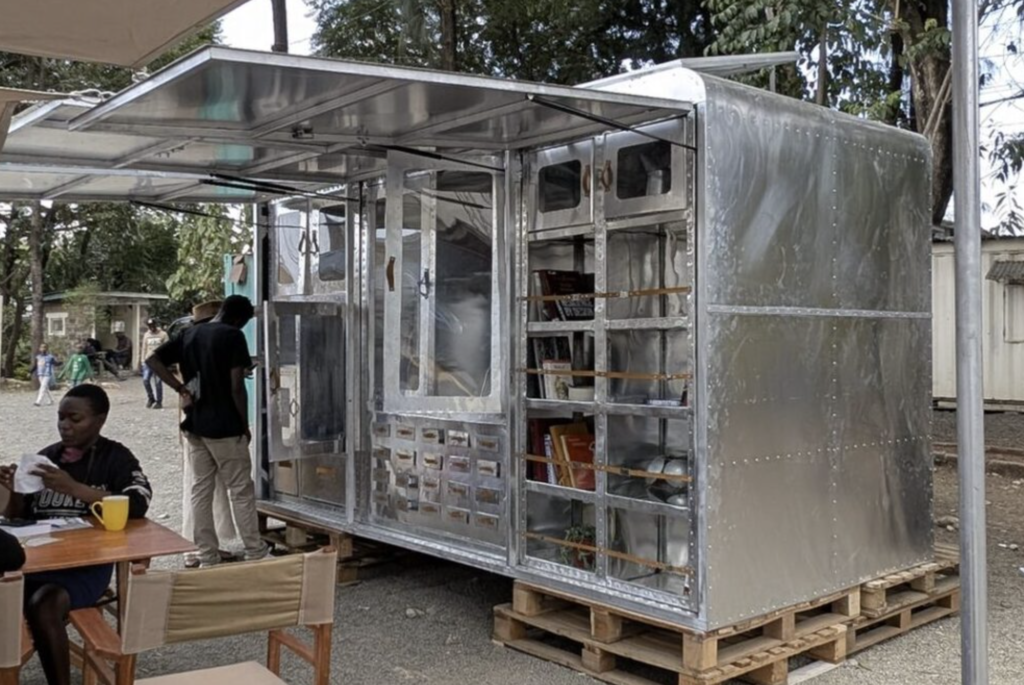
Safari Studio is a travelling creative and design workshop that temporarily stations itself within rural communities. It brings tools, materials, mentorship and methods for imagining and prototyping locally rooted futures.
The broader Kairos Futura initiative uses speculative design, art and ecological thinking to help communities envision alternative futures. Its mobile, off-grid studio is designed to travel between Nairobi and outer Kenyan communities to aid participants in creating projects using locally available resources.
How it works
The studio selects approximately 15–20 participants and remains in the community for roughly twelve weeks. The process begins with foundations in creativity and design: observing local systems, identifying challenges, imagining alternatives and learning how ideas can be developed through drawing, research, making and experimentation.
Participants then move into project development. They receive access to mentorship, tools, materials, resources and a small stipend that gives them space to develop an idea. Wherever possible, projects use materials, knowledge and opportunities already present within the surrounding community.
The outcome is not limited to producing a finished object. Participants practise seeing themselves as people capable of investigating a problem, proposing a response and taking action. The studio creates temporary infrastructure, but the deeper goal is to leave behind confidence, relationships and an expanded sense of possibility.
Challenges
A twelve-week programme cannot remove the structural barriers facing rural communities. Participants may develop strong ideas but still lack long-term finance, manufacturing infrastructure, market access or political support after the studio leaves.
Another challenge is maintaining momentum. Local agency should not become an excuse for governments, companies or powerful institutions to avoid their responsibilities. Telling people they have the power to act must be combined with recognition of the systems that limit their choices and the push for those in other positions to use their power as well.
What changes
Participants begin to identify resources, relationships and possibilities that were previously overlooked. Local materials, environmental problems or cultural practices may become the foundation for imagining a new service, product, space or form of livelihood. The community engages more as partners and active creators rather than passive recipients and it the program fosters imagination as a shared civic capacity. Dreaming connects with research, making and collective action rather than remaining an abstract idea or exercise.
What makes it regenerative?
Safari Studio regenerates agency and imagination. It helps communities recognize that the future does not have to be imported from elsewhere and that innovation can begin with local people, knowledge and materials.
Its approach is regenerative because it builds on and fuels innate capacity rather than delivering a temporary solution. The studio does not position itself as the saviour. It provides conditions in which participants can see their own ability to influence the future and then the means to practice doing so.